
Security Controls
Kindo maintains security, auditing, and compliance controls to ensure users and agents operate within organizational requirements. Access these controls via Settings (gear icon) > Organization > Model Access & DLP.
Model Access & DLP
Section titled “Model Access & DLP”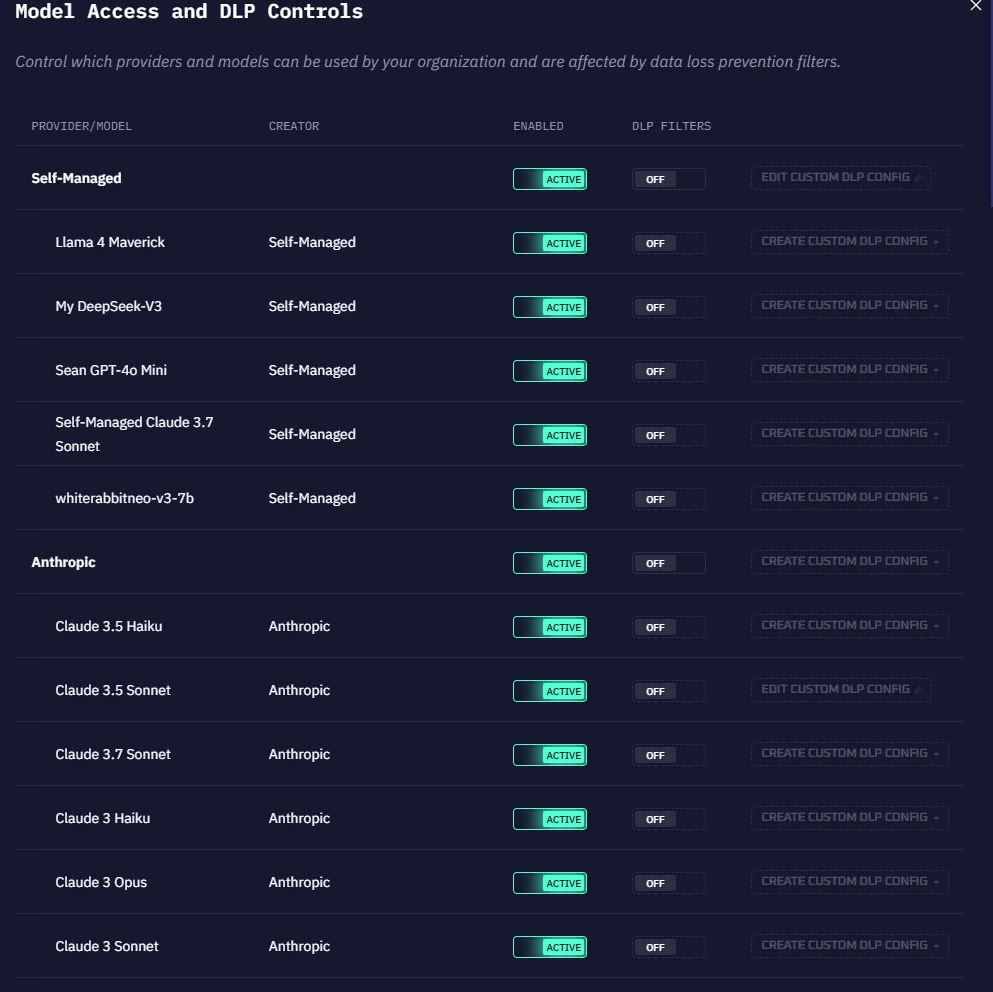
This section manages which AI models are enabled for your organization.
- Active — Users can access the model; agent and API requests succeed.
- Disabled — The model is hidden from users; agent and API requests to it will fail.
You can also enable or disable DLP filters for specific models and manage model versions from this screen.
Default Settings
Section titled “Default Settings”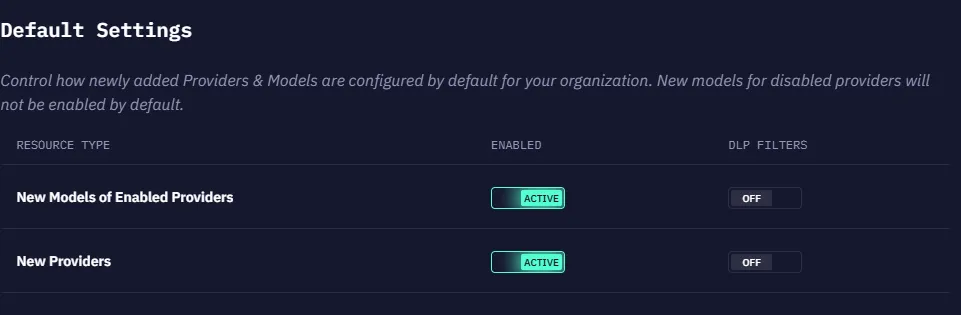
Configure default behavior when new models are added:
- New Provider — Whether adding new model providers is permitted in your organization.
- New Models of Enabled Providers — Whether new models from an already-enabled provider are activated by default.
Data Loss Prevention (DLP) Filters
Section titled “Data Loss Prevention (DLP) Filters”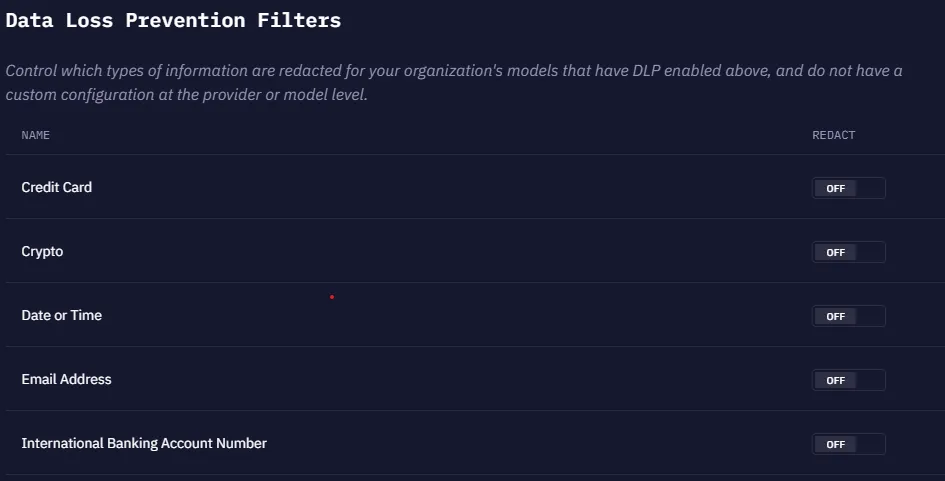
DLP filters are redaction mechanisms that tokenize sensitive data in outbound requests to AI models. When enabled, sensitive information is automatically masked in chat, agent, and API calls before reaching the model.
Kindo includes several built-in DLP filter types. You can also add your own filters to two lists:
- Custom Filters — Text that Kindo redacts.
- Custom Allow Filters — Text that the built-in filters leave unredacted.
Each custom filter is a Phrase or a Regex (regular expression).
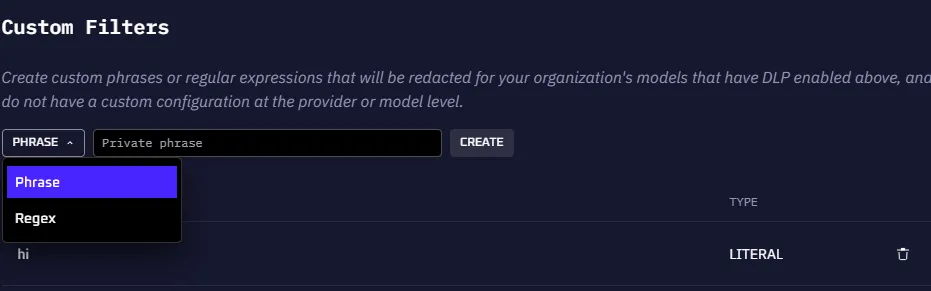
Custom Filters
Section titled “Custom Filters”Kindo replaces each match of a custom filter with REDACTED before the request reaches the model.
- Phrase — Matches the text you enter as whole words, ignoring case.
Project Falconmatches “project falcon” but not “Project Falconry”. Start and end the phrase with a letter, digit, or underscore: a phrase that starts or ends with punctuation or an accented letter, such asC++orCafé, may never match. Use a Regex for those. - Regex — Matches the expression anywhere in the text, ignoring case. Write it in JavaScript regular expression syntax; MDN’s regular expressions cheatsheet summarizes the syntax. Kindo evaluates the expression without the Unicode (
u) flag, so Unicode property escapes such as\p{L}and code point escapes such as\u{1F600}do not work.
| Regex | Redacts |
|---|---|
EMP-\d{6} | Employee IDs such as EMP-004217 |
acct[-_ ]?\d{8} | Account numbers such as acct-12345678 and ACCT 12345678 |
\b(?:falcon|osprey)\b | The codenames Falcon and Osprey as whole words |
Kindo rejects an invalid regex when you create it. A valid regex is still skipped, with no error shown, if it:
- Is longer than 1,024 characters.
- Uses a backreference, such as
\1or\k<name>. - Contains two quantifier characters in a row (
**,++,*+,+*,?*, or?+), even when they are escaped or inside brackets, such as\*+or[+*]. - Applies a quantifier (
*,+,?, or{n}) to a group that already contains one, such as(\d+)+or(-\d{4})?. Add each variant as its own filter instead.
Custom Allow Filters
Section titled “Custom Allow Filters”Allow filters keep text that a built-in filter would otherwise redact, such as a public support address that the Email Address filter matches. They do not override custom filters: text that matches a custom filter is still redacted. Kindo combines the allow filters from every DLP configuration that applies to a request, so an allow filter in a user group’s configuration also keeps text that the organization’s built-in filters would redact, for that group’s members.
- Phrase — Keeps a built-in match only when the matched text is exactly the phrase, including case.
[email protected]keeps that address from the Email Address filter, but not[email protected]. Each built-in match is checked on its own: the URL filter also matchesexample.cominside the address, so when URL is on, use a Regex such assupport@example\.cominstead. - Regex — Keeps a built-in match that starts or ends inside text the expression matches, ignoring case. Write the expression to cover the whole value you want to keep, such as
support@example\.com.
The built-in filters evaluate allow expressions with Python regular expression syntax, but Kindo checks the syntax only as JavaScript when you create the filter. Use syntax both languages share, such as character classes, quantifiers, groups, alternation, and anchors. In particular:
- If Python cannot read an allow expression, requests those DLP settings apply to fail until you fix or delete the filter. For example,
\k<name>,\cJ, and[^]are valid JavaScript but not valid Python. .also matches a line break, and^and$match at the start and end of every line.- Avoid open-ended
.*or.+. A built-in match that starts or ends anywhere inside the allow match is kept, so a broad expression can leave much more text unredacted than you intend.
Integration Access
Section titled “Integration Access”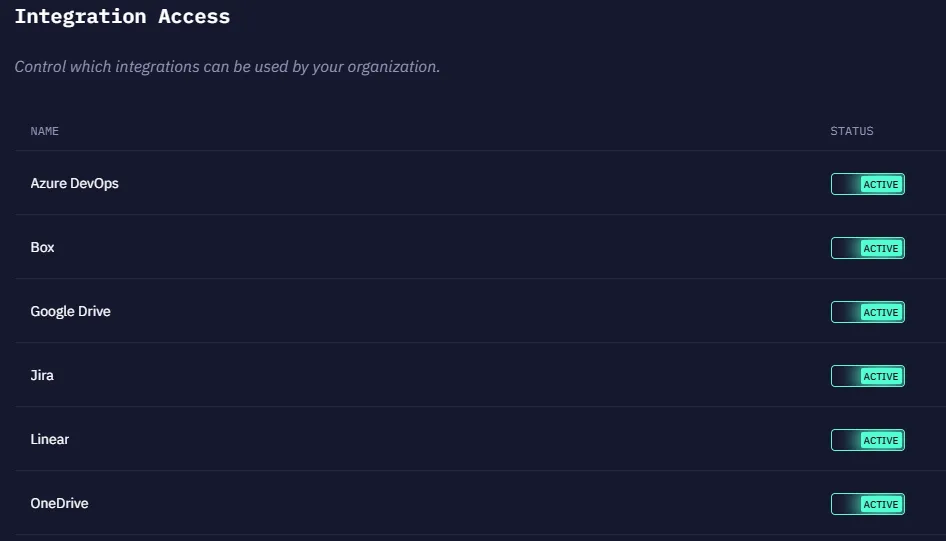
Control which integrations are available to users:
- Active — Users can use the integration to connect with external systems.
- Off — The integration is unavailable to users in the organization.
For per-user-group overrides and per-tool granularity, see Tool Action Access Controls. For the enterprise pattern of isolating an integration to a single team (e.g., legal, finance), see Integration Identity Isolation.
Audit Log
Section titled “Audit Log”Kindo records audit events whenever users, AI agents, or administrators perform actions within the platform. These events are retained in a log to provide a record of activity for security review, compliance, and incident investigation. Audit logging is available to organizations on the Enterprise plan.
What the Audit Log Captures
Section titled “What the Audit Log Captures”Every audit event includes a timestamp, the acting user, the organization, and structured metadata. Events fall into three categories:
- User actions — Chat messages, file uploads, workflow management, connecting and disconnecting integrations, API key and secret management, copilot activity
- AI agent actions — Tool executions (success/failure), LLM requests, sandboxed code execution, DLP filter events
- Administrative changes — Member and invite management, user group changes, security configuration updates, model management, organization settings
Full event type reference
User actions: Creating chats, sending messages, sharing conversations, uploading/removing files, creating/updating/deleting workflows, connecting and disconnecting integrations, managing API keys and secrets, copilot usage, viewing and exporting audit logs.
AI agent actions: Successful and failed tool calls, LLM inference requests, sandboxed code runs, Script step runs, DLP filter redactions, automated API step generation in workflows. Successful tool calls that load a skill or read one of its files, and Script step runs, record the skill’s name and version.
Administrative changes: Adding/removing/changing roles for members, managing invitations, creating/updating/deleting user groups, updating security settings, configuring tool servers, managing sharing permissions, creating/deleting DLP patterns, adding/removing models, changing organization settings, and Cross App Access configuration and client actions — saving or deleting the configuration, creating or revoking a client, and approving a CIMD client.
Each Cross App Access token issued or denied is also logged, but as a system event with no acting user — it isn’t attributed to an admin or end user, so it’s excluded when filtering the log to user-initiated events. A token is logged as denied only once the organization is identified; an earlier failure (invalid client credentials, a malformed assertion, a missing or unrecognized audience tenant ID, or an untrusted issuer) is recorded only in server logs.
Viewing Events
Section titled “Viewing Events”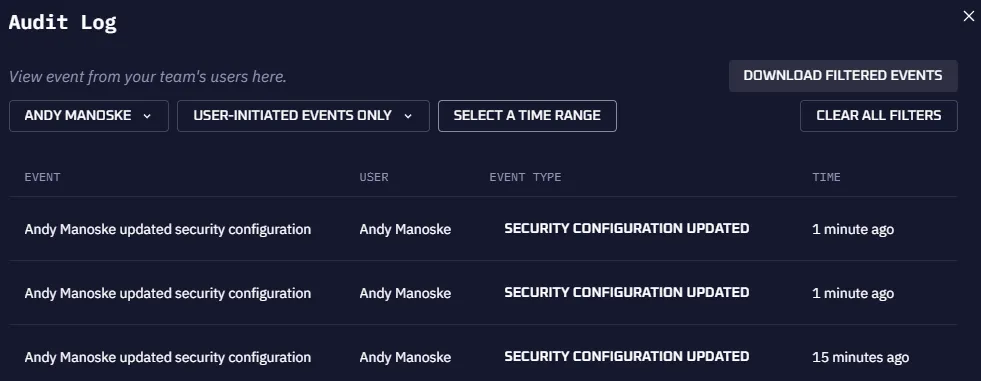
Navigate to Settings > Organization > Audit Log to view events.
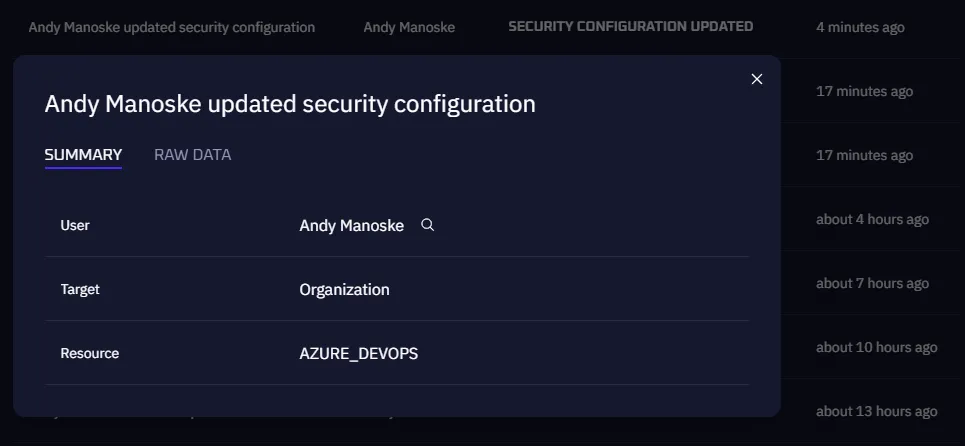
Filter by:
- User — Events from a specific user
- Activity type — Filter by event category or specific event type
- Date range — Narrow results to a specific time window
Event Details
Section titled “Event Details”Click any event row to view its full details:
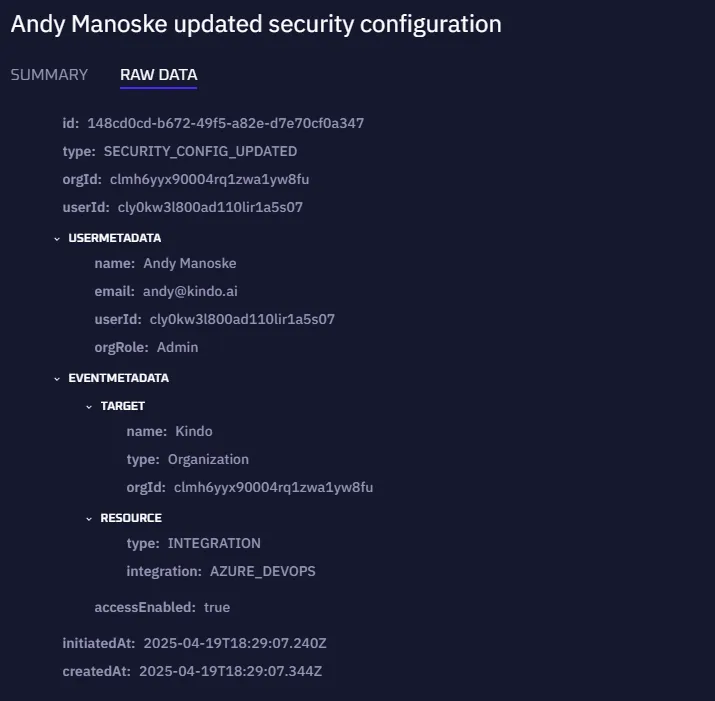
- Summary — Human-readable description of the action
- Raw Data — Full JSON payload including files accessed, metadata, and contextual information
Exporting Events
Section titled “Exporting Events”Click Download CSV to export filtered events. Kindo generates the CSV asynchronously and emails a download link to you. The link expires after a set period.
Investigating with Platform Tools
Section titled “Investigating with Platform Tools”Organization admins can also investigate the audit log by asking Kindo. Two Platform tools read your organization’s audit events: platform_list_audit_events lists events by date, user, and event type, and platform_get_audit_event reads one event’s full details. They suit questions that span many events, where the viewer opens each event’s details one at a time. For example:
- “What admin changes did this member make last week, and what did each one change?”
- “Summarize every failed tool execution since Monday by tool and error.”
If Platform is enabled for your organization, you can use the tools in:
- Chat: Platform is on by default in chats you start yourself; see Tools.
- Agents: Select Platform in the agent’s Tools settings. The tools check the access of the person the agent runs as. An agent started by a schedule or trigger, such as a scheduled agent that posts a weekly audit digest, runs as its creator, so it can use the audit tools only while its creator is an organization admin.
- External MCP clients: Available when your organization’s approval setting allows external tool calls; see the MCP quickstart.
Keep these in mind:
- Only organization admins see or can call the audit tools.
- Only Enterprise organizations record new events, but admins can read retained events through the tools on any plan, including after a downgrade from Enterprise.
- A page of results holds at most 100 events, and fewer when events are large, so a broad question can take several pages.
- System events, such as LLM requests and Cross App Access token events, are left out unless the call sets
include_system_eventsor names the event type. - Dates in a call must include a timezone, such as
2026-11-02T00:00:00Z. - While your organization records audit events, each page of results is also logged as an
AUDIT_LOG_VIEWEDevent. - An event’s full details can include chat messages, prompts, tool inputs and outputs, and error messages. They become part of the chat or agent run, and of anything written from them, such as a digest an agent posts. Check who can read that destination before you share it or point an agent at it.
- The log holds only the events Kindo records, so a missing event does not prove an action never happened.
See the tool catalog for exact filters, pagination, and size limits.
Storage
Section titled “Storage”Audit events are written to Kindo’s application database by default — no additional configuration required. Events are queryable in the admin UI and exportable as CSV.
Troubleshooting
Section titled “Troubleshooting”Events not appearing — Confirm the organization is on the Enterprise plan and that the AUDIT_LOG_DISABLED feature flag is not enabled in Unleash.
CSV export email not received — Verify SMTP is configured correctly for the Kindo task worker and that the requesting user’s email address is correct.
Sharing Permissions
Section titled “Sharing Permissions”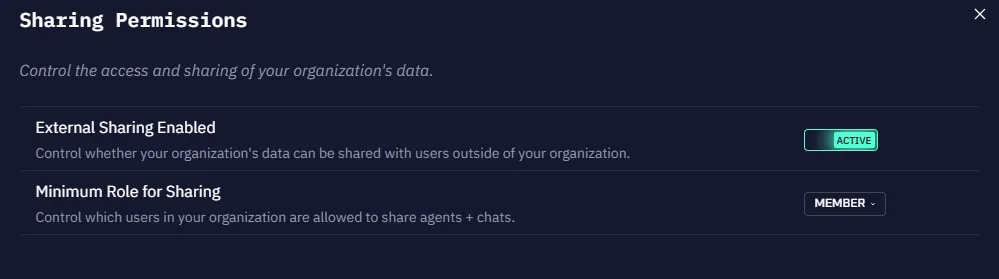
Control who can share agents, chats, and skills, and whether anything can be shared outside the organization:
- External Sharing Enabled: when active, users can share links to chats or agents with people outside the organization. An agent shared this way brings its attached skills with it; see What an Attached Skill Reaches. When disabled, users cannot share with anyone outside their configured identity provider.
- Minimum Role for Sharing: the lowest role that can share. Set it to Admin so that only administrators can share agents, chats, and skills; set it to Member to let every user share.